What VALORANT Champions Shanghai group stage day 7 delivered for the 2026 world title race
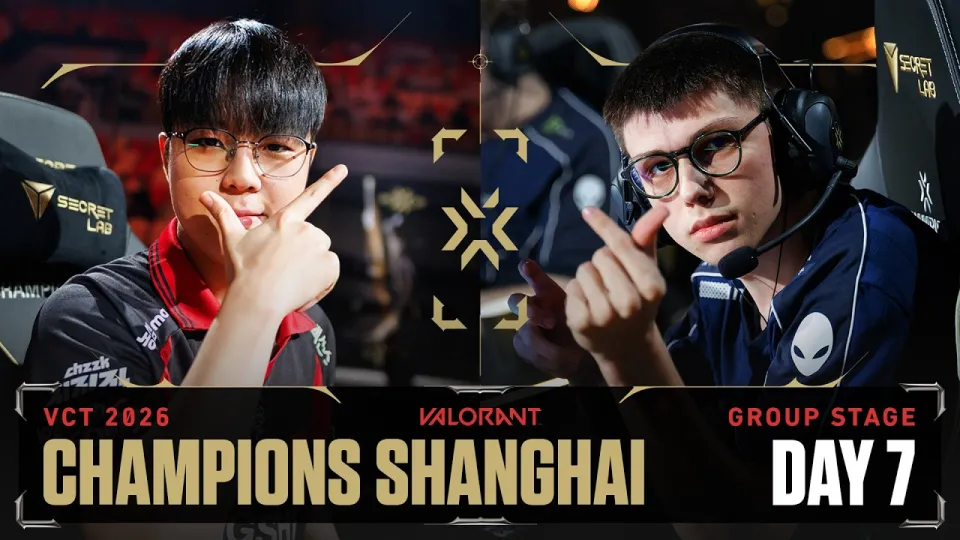
Video: VALORANT Champions Shanghai — Group Stage — Day 7
Want articles like this for your own video to promote it on YouTube and Google? Order them through the Telegram bot @sat_sit_bot. Articles with your video embedded are written and posted by the bot itself — on popular topical sites (no ads). Free trial — 50 articles.
· based on the channel VALORANT Champions Tour
VALORANT Champions Shanghai is the final international event of the 2026 season, where sixteen teams from the Americas, CN, EMEA and Pacific compete for the world title between September 24 and October 18. Day 7 of the group stage, broadcast by the VALORANT Champions Tour, narrowed the field further and turned the conversation toward which regions actually deserve their slots. For live updates and the official schedule, the tournament's news feed is tracked via the VALORANT Esports X account.
The format is unforgiving: group stage matches decide seeding and survival, and every map played in Shanghai carries weight for the playoff bracket that follows. That is why a single day of group play can reshape the entire narrative of a world championship.
How the VALORANT Champions Shanghai group stage is structured
The group stage is the filter between sixteen qualified teams and the playoff bracket, and it is designed so that no region gets a free pass. Teams arrived through their regional circuits in the Americas, China, EMEA and Pacific, and the group phase mixes them against unfamiliar opponents — the exact scenario where preparation and adaptability matter more than domestic form.
Key structural points to keep in mind while watching:
- Sixteen teams total, split across groups, with only the top finishers advancing.
- Matches are best-of-three in the group phase, which rewards map depth over a single strong pick.
- Seeding from groups determines playoff paths, so winning a group is materially different from scraping through.
- The event window runs from September 24 to October 18, making the group stage a compressed sprint before the bracket.
Day 7 sits deep enough into that schedule that teams are no longer hiding strategies. Drafts become readable, pistol-round tendencies get scouted, and the teams with shallow map pools start to look exposed.
Why 2026 feels like a changing of the guard
The 2026 season produced two different Masters champions, and that fact alone reframes Shanghai as an open tournament rather than a coronation. When the same organizations keep lifting trophies, the world championship becomes a formality; when two separate rosters win the mid-season events, the biggest trophy of the year becomes genuinely contested.
The description of the Day 7 broadcast leans into that framing directly, describing familiar names, new contenders and a fearless generation of challengers converging on a city where history and the future sit side by side. In practice, that means veteran rosters with deep playbook knowledge are being pushed by younger teams whose mechanics and aggression compensate for inexperience.
For viewers, the practical takeaway is that group-stage results in Shanghai should be read as evidence of ceiling, not just form. A team that wins a map against a Masters champion in a group has demonstrated it can do so again in a playoff series.
The technical pauses that shaped the Day 7 broadcast
Repeated technical pauses interrupted the Day 7 stream, and the audience noticed immediately. Chat commentary focused on the frequency of stoppages, with viewers joking about an endless series of them and asking why so many occurred in a single broadcast day.
From a viewer's perspective, the practical consequences are concrete:
- Momentum in a best-of-three is real, and long breaks between rounds or maps can cool a team that was rolling.
- Pause-heavy broadcasts stretch a VOD past the point where casual viewers can follow it live, which pushes people toward spoiler-free timestamps.
- Production issues are rarely the players' fault, but they distort the sample size fans use to judge performance.
If you are watching the VOD after the fact, skipping between map starts is the sane approach; the broadcast itself is long enough that watching every pause adds nothing.
What the audience is saying about China's representatives
The most pointed criticism on Day 7 targeted the Chinese teams, and it was specific rather than generic. Fans highlighted lost eco rounds, thrown 5v2 advantages and utility usage that looked improvised once set strategies broke down.
That critique deserves nuance. Losing to a saved-up pistol or a stacked eco is usually a discipline problem — over-peeking, poor spacing, or a retake executed without utility. Losing 5v2s is worse: it signals communication breakdown under pressure, because the advantage is numerical and the correct play is to trade slowly and force the opponents into a single chokepoint. When both happen in the same series, the pattern is not bad luck.
The counterargument from other viewers is that the region's depth is underrated and that stronger Chinese teams simply did not qualify. Either way, the group stage is where that argument gets settled on the server rather than in comment sections.
Individual storylines worth tracking beyond the scoreboard
Star players and role specialists drive more of the group-stage narrative than team records do. Commentary around Day 7 singled out veteran leadership as a deciding factor, and the same names keep appearing because the players who handle pressure are the ones who close out tight maps.
Three things to watch as the bracket approaches:
- Duelist output on attack halves — teams that cannot open sites cleanly will not survive a best-of-five.
- Sentinel discipline in retakes, especially on maps where the site has one narrow entrance.
- Utility sequencing on eco and bonus rounds, the exact area critics flagged in China's losses.
A single standout performance in the group stage rarely wins a championship, but it frequently decides which team gets a favorable playoff path.
How to follow the rest of VALORANT Champions Shanghai
The tournament runs through October 18, and the group stage results feed directly into the playoff bracket. Official channels publish match schedules, results and behind-the-scenes content, and the broadcast itself remains the primary source for map-level detail.
Where to look:
- VALORANT Esports on X for announcements and schedule updates
- Facebook and Instagram for clips and event photography
- TikTok for short-form highlights
- Twitch for live broadcasts and rebroadcasts
The event is supported by partners including AWS, Coinbase, EWC, ENC, Globant, HyperX, Mastercard, OnePlus, Red Bull, Secretlab and Verizon.
Final word on the group stage race
Day 7 of VALORANT Champions Shanghai made the group stage legible: the teams with map depth are separating from the ones relying on a single comfort pick, and the two Masters champions of 2026 have genuine challengers rather than a clear path. The technical pauses were a production annoyance, not a competitive factor, and the criticism of China's representatives is fair on the specific rounds cited but premature as a verdict on the region. What matters now is how those teams respond in the bracket, where a single bad half ends a season. The full Day 7 broadcast and further coverage come from the VALORANT Champions Tour channel, and schedule updates land first on the official VALORANT Esports X account.
Key takeaways
- VALORANT Champions Shanghai runs September 24 to October 18, with sixteen teams from Americas, CN, EMEA and Pacific.
- Day 7 of the group stage is the seventh broadcast day of the event, published by the VALORANT Champions Tour channel.
- Two Masters events in 2026 produced two different champions, setting up Shanghai as the year's deciding trophy.
- Viewers flagged repeated technical pauses during the broadcast, a recurring talking point in the chat.
- Chinese representatives drew heavy criticism from fans for losing eco rounds and 5v2 situations.
Questions & answers
How many teams compete at VALORANT Champions Shanghai?
Sixteen teams qualify, drawn from the Americas, China, EMEA and Pacific regions. They are split into groups, with only the top finishers advancing to the playoff bracket. The event runs from September 24 to October 18.
Why were there so many technical pauses on Day 7?
The broadcast was interrupted by repeated technical stoppages, which viewers noted in large numbers. The official stream does not detail the causes, but pauses of this kind are usually production or server-side issues rather than player problems. They stretch the VOD considerably and can interrupt a team's momentum.
Are the Chinese teams really the weakest region at the event?
Fans pointed to specific mistakes — lost eco rounds, thrown 5v2 advantages and improvised utility once set plays broke down. Those are real execution errors, but a group stage sample is small and does not prove regional depth. The bracket is where that argument gets resolved.
Where can I watch the rest of the tournament?
Live matches air on the official VALORANT Twitch channel and the VALORANT Champions Tour YouTube channel, with clips distributed on TikTok, Instagram and Facebook. Schedule announcements and results are posted first on the VALORANT Esports X account.
Source: VALORANT Champions Shanghai — Group Stage — Day 7 · Markdown version